Everyone is trying to scramble nowadays to find how to easily bounce back after this pandemic. And with the uncertainty of time and the unlikely end of this crisis in the soonest, many are resigning themselves to get by just so they can still have some investments until the vaccine is found for Covid-19.
One of the most surprising things that happened is the way that this crisis has affected the real estate industry. The seeming immovable investment has been shaken along with all other industries.
This is why there are plenty of studies being conducted and simulations being done to see how to bounce back with the least amount of damage or the fairest amount of return for investments made pre-pandemic.
While those assessments are still being evaluated, what can be done is properly plan out what to do in case the cure is found soon. The damage has been done, so what actions can be taken to win in the future even if another virus disrupts our everyday life?
One of the most notable and realistic strategies is to focus on value sustainability.
This idea has been around for quite some time and is getting more and more attention because of the more secure structure it offers compared to like strategies.
In this article, we will look at the things you need to know about value sustainability and how it can fit into your future investment plan.

The Real Estate Scenario
Real estate is very capital intensive and requires long-lead times. In the past, either “overvaluation” or “overleveraging” created economic mayhem in the macroeconomy for several years. This can no longer be acceptable – for any reason.
The stakes are now too high, as correction (bailout) tools are now stretched beyond recognition. Current research data, computer software, subsidy tools, and the timing of data are better and faster now than ever. Thus, underwriting must follow suit.
Moving forward, “value sustainability analysis” needs to be a significant lending or project requirement. In substance, this tool is a highly functional “sensitivity” analysis that can be used to model risk, loan and investment metrics, real estate cycles, and loan terms in a single window and in real-time.
This tool is scalable to an enterprise-level or can be used to pluck single asset metrics from a portfolio. The key, however, is that all real estate factors (i.e., demographics) must be tied more closely to each property’s underwriting so that unnecessary speculation cannot occur.
More specifically, investors must accurately value assets today, fully underwrite down periods, and forecast whether that “fundamental” value is “sustainable” over the survey window.
Credible Valuation and Risk Forecast Modeling Through ‘Value Sustainability’
“Sustainable Value” is described in Guide Notes 10 & 12 of USPAP. It is not a new concept, nor is Value Sustainability hard to conceptualize. Simply place yourself in the position of a lender, buyer or investor and ask whether that purchase will hold its value over the time you plan to own/lend on it.
Unlike a new car, which is expected to depreciate from the moment it is driven off the lot and is treated as a consumable, real estate values are expected to be durable, or ‘sustainable’ over a loan term or hold period. “Value Sustainability”, developed correctly, and used at each stage of the real estate transaction period will help investors, lenders and analysts navigate this market blind spot that we now face as a result of the COVID-19 pandemic.
What is Value Sustainability?
Value Sustainability Analysis is a forward-looking yield capitalization model that compares market value and its implied reversion to “fundamental value” and its implied reversion over a cycle period and along a market equilibrium line.
Detachment from equilibrium by a margin of 15% or more implies either that the surrounding market fundamentals will not support that valuation through its holding period (the asset is overvalued by the collective market and not necessarily an appraisal and potentially in a market ‘bubble’), or that market fundamentals are pointing to an undervalued asset (by the collective market and not necessarily an appraisal) – and a buying opportunity exists.
The Sustainable Value Model
The starting point of sustainable value analysis is market value. Appraised value, (presumably well supported and reflective of a stabilized value at market rents) is identified. Note that sustainable value is also a functional model for stress testing list prices, screening offers, or identifying loan risk.
Under such scenarios, the start point is a target, contract, or offering price. Carefully sourced investor all-cash yield rates then fuel sustainable value calculations. The all-cash yield is most appropriate as a factor that encompasses the full spectrum of investor criteria and risk; it is forward-looking; and which is fluid enough to have priced in market downside (or upside) expectations.
It is important to understand that the starting point, (appraised or target value), should still incorporate market support and real-time assumptions of typical risk, (i.e. market rent and trends, vacancy and collection loss, expense trends and overall capitalization rates).
The known market value or target benchmark is presumed to be credible. Its value sustainability over a cycle, then, is the target measurement and the true opportunity or downside risk barometer.
Net Operating Income, (NOI) and its growth (or movement) over a hold period are known or a forecast annuity. An all-cash yield (ACY) is then applied in place of a terminal rate to calculate Fundamental Reversion.
Use of the ACY as a residual rate along the fundamental value equilibrium line filters out irrational market exuberance or fear and is then used to “reverse engineer” the “as is” fundamental value. The same yield expectation is used to trend the appraised value reversion. The output is illustrated as follows.
Key Metrics and Measurements
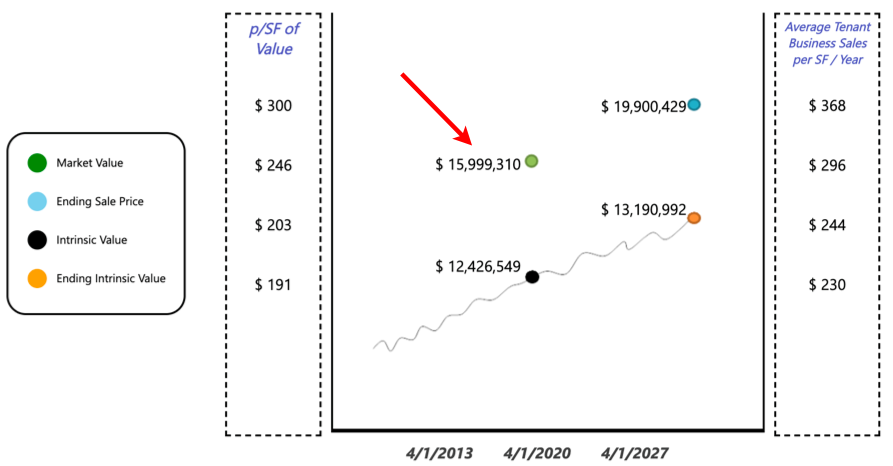
The chart above illustrates a Sustainable Value Analysis with a starting point (appraised or benchmark value); its projected reversion and the fundamental as-is value and its reversion. In the chart above, a seven-year cycle is shown, and an implied equilibrium line connects the fundamental values.
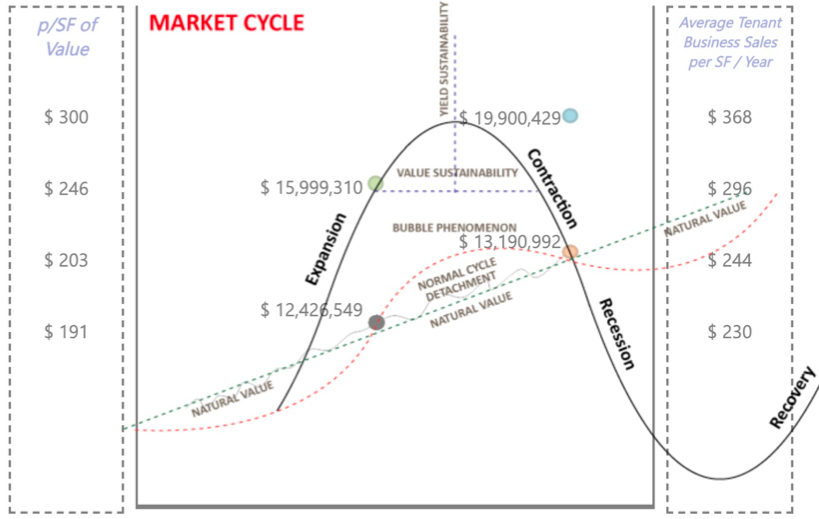
The position of appraised value relative to its as is fundamental value and reversion in the above chart does imply that over the course of the surveyed cycle, market gravitational forces will work to pull the appraised value down to its fundamental reversion.
Normal cyclic activity is shown within the window but a de-coupling from the equilibrium line by 15% or more is an indicator that the current appraised value is not sustainable over the term under study.
Post Covid-19, this type of underwriting will be required to prevent ongoing value losses.
Conclusion
As we have seen, value sustainability has its own ups and downs as with other strategies. What is important is that you decide wisely and with confidence, which you can do so with the proper knowledge and familiarity of the investment you’re making and the plan that you are implementing.
With the unpredictability of this pandemic, the best thing to do now is to sit and wait it out and use the available time to come up with innovative solutions and plans you can implement when the virus is defeated.
Like most investors itching to get back in the game, don’t let yourself slack off and get left behind when the doors of opportunity have once again opened.
ENRICHEDREALESTATE.COM
Provides the highest quality and most detailed commercial real estate data, FREE, through crowdsourcing to supplement a national commercial real estate database with 32 million records.
Comments
Post a Comment